Sunflower Circle Frame
A Designer’s First Glance: Warm, Balanced, and Ready for Real Fabric
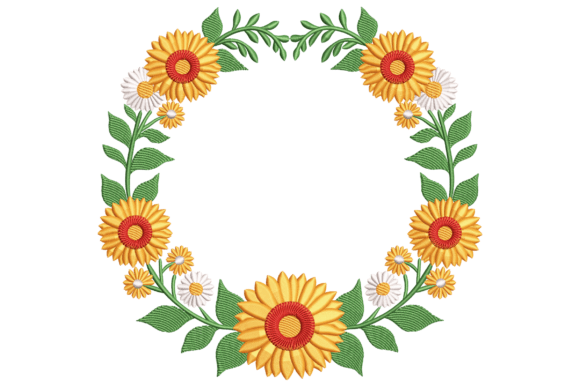
When I opened Sunflower Circle Frame for the first time, I didn’t just see a floral wreath—I saw intention. The circular layout feels grounded, not fussy; the sunflowers are bold but not overwhelming, with petals that suggest motion and centers that hold visual weight without crowding. It reads as cheerful but mature—ideal for a boutique tote bag or a linen tea towel meant to last seasons, not just one craft fair weekend. As a machine embroidery design, it leans into classic floral warmth while avoiding cliché. That matters when you’re building a cohesive line of handmade products or curating an Etsy shop where customers scroll past dozens of “cute” designs in under three seconds.
How It Lives on Actual Projects—Not Just Screens
Last week, I stitched Sunflower Circle Frame onto a heavyweight cotton canvas tote for a local florist’s pop-up. No mockup, no filters—just hoop, stabilizer, and real-world expectations. On fabric, the design held its shape beautifully: the outer circle gave structure, the sunflowers had enough breathing room between them to read clearly at 4.5 inches wide, and the overall stitch density felt generous without being heavy. It didn’t sink into the weave or puff awkwardly—it sat confidently, like it belonged there.
I’ve also tested it on a lightweight baby onesie (with tear-away + cutaway stabilizer combo) and a looped terry kitchen towel. On the onesie, I scaled it down to 3.2 inches—still legible, still charming. On the towel, the fill stitches stayed crisp despite the texture, thanks to thoughtful spacing between petal layers. That’s not luck. It’s evidence of smart digitizing: balanced satin stitch curves, intentional running stitch accents for stem detail, and fill areas that breathe instead of flattening out.
Where It Shines—and Where to Pause
Sunflower Circle Frame is strongest on stable, medium-weight fabrics: denim aprons, twill caps, linen pillow covers, organic cotton sweatshirts. It’s a natural fit for holiday embroidery (think sunflower-adorned Thanksgiving tea towels or spring baby blankets), personalized gifts (monogrammed center optional), and small shop merchandise where visual warmth builds brand trust.
That said, I’d avoid it on ultra-stretchy knits without significant stabilization—or on curved surfaces like structured baseball caps—unless you’re willing to test multiple hooping angles and stabilizer layers. The outer circle and petal tips are clean, but they’re not built for aggressive distortion. On dark fabric, thread color contrast becomes critical: a warm gold or mustard yellow pops more reliably than pale yellow, which can disappear on charcoal or navy.
It’s not an applique design, so don’t expect raw-edge charm or fabric-layer depth. And while it’s lovely on patches, keep in mind that dense fill areas may stiffen the backing—test on your preferred patch material before committing to 50 units for a craft fair.
What This Design Says About Your Finished Product
Customers don’t buy stitches—they buy feeling. Sunflower Circle Frame quietly signals care: the kind that chooses quality over speed, warmth over trend-chasing, clarity over clutter. When stitched cleanly on a well-made tote or pillow cover, it elevates the whole item—not just as a decoration, but as proof that the maker paid attention to proportion, balance, and wearability.
For Etsy sellers and creative entrepreneurs, that translates directly to perceived value. A customer scrolling past generic floral files will pause for this one—not because it’s flashy, but because it looks *considered*. That builds trust. That encourages repeat orders. That makes your handmade product feel like a quiet promise: “This was made thoughtfully, for someone who’ll use it—and love it—for a long time.”
Practical Notes Every Embroidery Designer Should Run Through
- Always test on scrap fabric first—especially if pairing with textured or dark materials. Stitch density looks different on screen than on towel loops or fleece backs.
- Check thread color contrast early. Sunflower yellows behave differently on ivory linen vs. black cotton. Try a quick black-and-white mockup to assess value separation.
- Confirm hoop size compatibility. The circular layout means width and height are equal—so a 5x7 hoop works, but a narrow 4x6 may require repositioning or scaling.
- Inspect small details at actual stitch-out size: petal tips, center texture, and circle continuity. What looks sharp at 200% zoom may blur when stitched at 4 inches.
- Use appropriate stabilizer for your base fabric. Lightweight cutaway for knits, medium tear-away for quilting cotton, and blended fusible + tear-away for terry towels.
- Verify licensing terms before selling finished items or bundling Sunflower Circle Frame into digital embroidery file packs. Commercial use isn’t automatic—even with floral wreaths.
- Compare light/dark backgrounds side-by-side in your design software. Some fill stitch patterns lose definition on low-contrast pairings.
Final Thought: A Reliable Anchor in Your Design Assets
Sunflower Circle Frame won’t shout—but it will resonate. It’s the kind of embroidery file I reach for when I need dependable charm: for a custom embroidered sweatshirt order from a teacher who wants classroom joy stitched into her uniform, for a set of nursery pillow covers where softness and clarity both matter, or for a small-batch run of aprons that represent a café’s sunlit, unhurried ethos.
It’s not trying to be everything. It’s doing one thing—celebrating sunflowers within a graceful, wearable circle—with focus, balance, and quiet confidence. In a landscape crowded with overly intricate or emotionally vague designs, that kind of clarity is rare. And for designers, craft business owners, and makers building something real? It’s exactly what we need.